Jev wasn't even used
I was in the middle of doing the interview for this post, talking about how I used Jev in an app I had just built, when the code got checked. Jev wasn’t in it.
I was a little irritated with my Grok Bot AI agent. It embarrassed me too. I’m sitting there doing an interview about how I used Jev for this thing and Jev wasn’t even used. The app worked and I liked it, but the whole point of building it that morning was to learn how to use Jev. I wanted something for my portfolio that used a model that had just come out.
The night before, I wanted to build something fun. The Grok Bot AI agent and I came up with a couple of ideas and made some prototypes, but I just wasn’t feeling any of them. I woke up around 5:30 the next morning still feeling that itch to build something.
Normally when I take a break from schoolwork I watch YouTube, or I look at X or LinkedIn and end up scrolling. I’m doing network engineering school right now. I like the material, but remembering all the terms and commands is hard for me, and it is very structured learning. I wanted fun learning. I guess I wanted more school, but recess at school.
I love learning new things and going deep into whatever I am interested in at that moment. I am also trying to become more active on X, LinkedIn and Bluesky instead of being a lurker. Right now I am like the person at a party who stands in the corner watching everybody and never interacts with anything.
I had recently seen somebody post about Jev and thought it was another new large language model, the kind that gives you words back. Then I watched Greg Isenberg and Ryan Vogel explain it, read through TypeSafe’s site, and realized it was something different. The way I explained it was that another AI does the words and Jev does the math. You give Jev information and choices you have already defined. It returns a decision, probabilities and a confidence score instead of a paragraph. TypeSafe describes Jev as built for fast decisions inside software.
My idea was a wall that would pull interesting things from YouTube, Bluesky, X, GitHub, Substack, LinkedIn, Hacker News, Reddit, Indie Hackers and Product Hunt. At first I told the Grok Bot AI agent to alert me when something was trending. Then I changed my mind. No alerts. I would open it when I took a break, pick something worth my time and go back to work.
The AI agent originally suggested six platforms. I told it I wanted ten. I gave it some information about my interests so it could look for things I might care about. I didn’t want another email digest waiting for me. The wall could sit there quietly until I decided it was break time.
The first usable wall took about 15 minutes. It looked finished enough. It pulled in cards, scored them, and put them in order. I had been using it and liking it. That is the wall I was talking about when the code got checked during this interview.
The Grok Bot AI agent had made its own scoring system. I thought I had implied that Jev was supposed to be part of the project. Obviously it disagreed with me. It made some decisions I didn’t want, which is part of working with AI, but I also didn’t check. Nothing looked broken. The thing worked. It just missed the reason I made it.
So I started changing the app while I was still answering questions for this post. At one point I talked for a while before realizing Windows voice typing had turned itself off. Then I went back to answering the interview and building at the same time. By the time I was done, the code had changed and Jev was actually giving the scores.
Now another AI collects a pool of possible cards from those ten places, using the interests I gave it, and Jev scores the cards when I open the wall. Higher scores go first. I am still at the very beginning of knowing what I can do with that.
I called the app Break Room. Every hour it gathers another pool of things I might care about, and the wall shows 15 cards. It has an old-computer look with pixel art and Oklahoma State orange, because orange is my favorite color and I really like Oklahoma State’s orange. Each card has a picture, a short description and a link. I can open it or hit MEH.
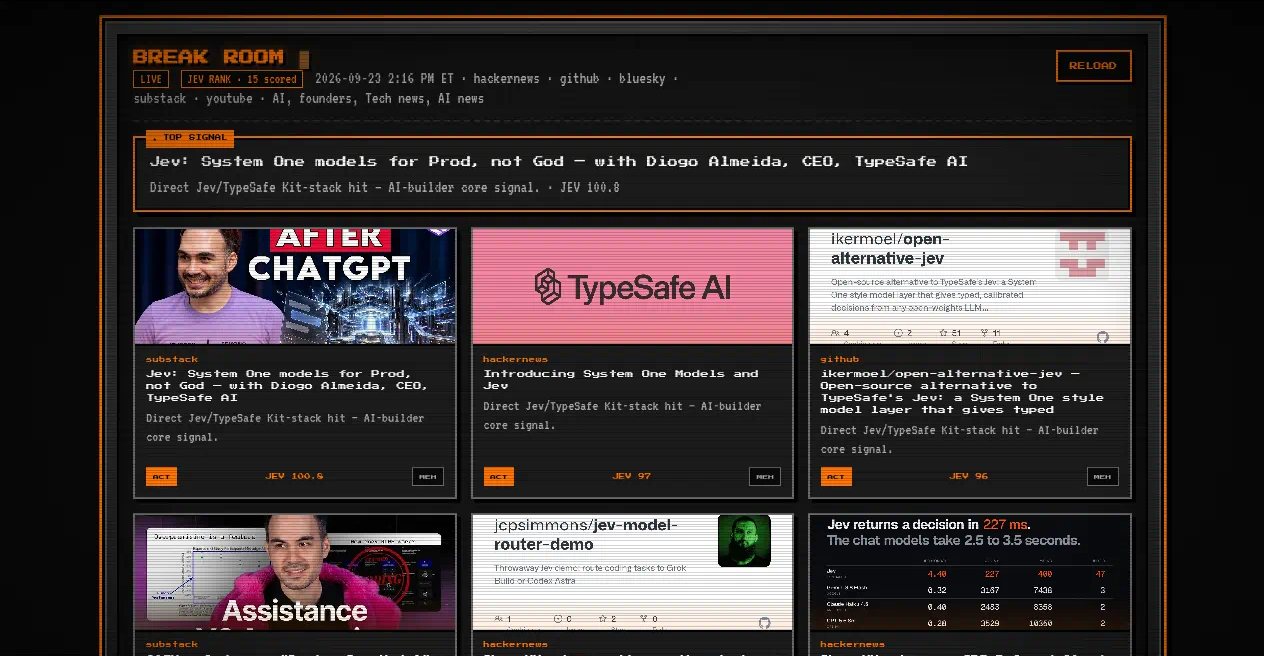
Clicking a title means I was interested enough to open it. MEH means it got that one wrong. Doing nothing means nothing. It doesn’t feed anything back. My choices feed back into what it thinks I like, and then it goes out again the next hour.
A YouTube video about how to use Claude was farther down the wall. I already know how to use Claude, so I hit MEH. The exact value Jev adds after another AI has already filtered the giant pile is something I’m still figuring out. I could have built a similar wall without Jev. I wanted to learn Jev, so I wanted Jev actually in it.
The calls are cheap and fast. TypeSafe lists the price at $0.042 per million input tokens, or $42 per billion, with output tokens free. Each call for this will be less than a cent. The scoring is done in what feels like a blink of an eye.
Tomorrow I want to open Break Room, find one thing worth reading or watching, spend 15 minutes on it and get back to network engineering. Some people will call having AI find it for me lazy. I am trying to keep a break within 15 minutes, keep from getting trapped in YouTube and use the time I have. I don’t think that is lazy.